
AT calvary
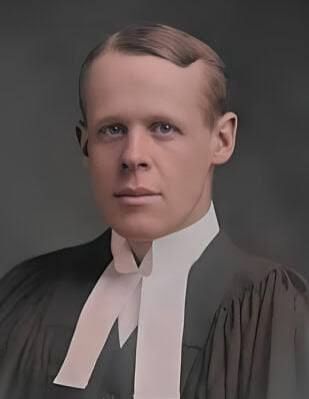
WILLIAM R NEWELL
William R Newell (May 22nd, 1868 - April 1, 1956) was born in Savannah, Ohio. His childhood was surrounded by the ministry as his pastor father dedicated his life to others. His widely known hymn of personal testimony, At Calvary, was written at the Institute one day when, as he walked to his next lecture, he was struck with the idea for this song. Ducking into an empty classroom, he quickly penned the lines on the back of a used envelope. Continuing to his class, Newell crossed paths with his friend, Institute music director Dr. Daniel B. Towner. He handed Towner the envelope in passing and asked the gifted musician to compose a tune for the lyrics. In retirement, William Newell moved to DeLand, Florida, where he died on April 1st, 1956.
D B TOWNER
Daniel Brink Towner (March 5, 1850 – October 3, 1919) was an American church music director, college professor, and composer of over 2,000 hymns and gospel songs, many of which are still popular today, the most notable being "Trust And Obey". He was also associated with other great evangelicals of the late 19th century, including evangelist Dwight L. Moody and songwriter Philip P. Bliss. He was the second child and oldest son of "Professor" J. G. Towner, a teacher and director of singing schools in the Rome area. On October 3, 1919, Dr. Towner was assisting in some evangelistic meetings in Longwood, Missouri. That evening he had led both choir and congregation in singing a number of great gospel songs, some that were his own and some written by others. When the time came for him to sing a solo, he chose one of his favorites, “Would You Believe?”, but as he began, he felt ill and tried to go on, but lost consciousness and slumped to the stage. Moved to a nearby hotel, he died a few hours later, the victim of acute kidney failure.
Song History
Notg much has been written about how At Calvary came to be except to say that that one day, while on his way to a class, the words for this hymn crystallized in Newell’s mind. He stepped into an unoccupied classroom and wrote down quickly on the back of an envelope the words as they now appear.
THE MUSIC
Moments after Newell wrote the lyrics to the song we know so well as At Calvary, he met D B Towner who was the music director at the same institute where he taught. He showed him the text with the suggestion that Towner try composing the music for the words. An hour later when Newell returned from his class, Dr. Towner had already completed the tune and with gratitude to God, they sang their new hymn together.
history
Thought to be one of the most loved songs of the Christian faith; many don't know how the song came to be. Few stories are as compelling and transformative as that of “Revive Us Again” and its author, Dr. William MacKay.
William P. MacKay was born in 1839. At the age of seventeen, he left his humble Scottish home to attend the University of Edinburgh to study medicine. His godly mother gave him a Bible in which she wrote his name and a verse of Scripture. Away from home, he began his studies well; as time went by he drifted further and further from the way he had been raised and began drinking heavily. At a particularly low point in his life, to satisfy his thirst for whiskey, he even pawned the Bible his mother had given him.
After graduating from medical school, his first assignment was to work in a hospital emergency room. During this stent, MacKay became acquainted with human suffering. Occasionally, he would witness the remarkable difference in the life of a person who had faith in Jesus Christ. He said that it was not strange for him to see the difference in a Christian because he had been raised in a Christian home by godly parents. His own mother had led him to Christ as a young man and prayed often for her son. The older MacKay grew, the more wicked he became; he came to believe he was in danger of becoming a thorough infidel.
One day a young man, was brought into the emergency room. He had fallen off a very tall scaffold and was in serious condition. William was assigned to attend to the young man. It was soon determined that because of his serious injuries, his case was hopeless. All William could do was relieve the young man’s pain as much as possible.
Dr. MacKay asked the young man, “Do you have any relatives that we can notify of your injuries?”
The young man replied, “No sir. I live alone in this world. However, would you please notify my landlady and ask her to come visit me. I owe her some money and want to pay her. Also when she comes, ask her to bring me my book”.
“What book?” Dr. MacKay asked.
“Oh just tell her to bring the book. She will know what book I am talking about,” the young man responded.
The landlady brought the young man his Bible, and the young man read it constantly. When he could not read it any longer he just laid his Bible on his chest and hugged it.
After one week the young man died. Afterwards, Dr. MacKay was called to his room by the nurses to fill out the necessary paperwork when one of the nurses asked Dr. MacKay, “What should I do with this Bible?” Dr. MacKay told the nurse that the young man had no relatives, and that she could just give him the Bible and he will dispose of it. While the nurses tended to the body of the young man,
Dr. Mackay opened up the front of the Bible and curiously looked at the first few pages. Suddenly, he slammed the Bible closed with a strange look on his face. A nurse noticed Dr. MacKay’s countenance and asked, “Are you alright?”
Dr. MacKay answered, “Yes, I am going to my office if you need me you can call me there.”
When Dr. MacKay arrived at his office he shut the door, sat at his desk, and opened the Bible once again. There it was – his mother’s handwriting. The Bible was inscribed by his mother and was the very Bible that Dr. MacKay’s mother had given him as he left home for medical school. The young man must have bought the Bible from the pawn shop where Dr. MacKay pawned it for drinking money. All the pages were well worn and some pages were loose. Many verses had been underlined.
Dr. MacKay thought about how this Bible brought comfort to this dying young man. It was the book that enabled him to die in peace and happiness. With a sense of shame, Dr. MacKay began to read some of the Bible verses that were underlined. He recounts, “Many verses I had heard in my younger years came back to me. The voice in my conscience could not be silenced any longer. With tears in my eyes, I prayed for God to forgive me and restore to me the joy of my salvation”.
Not long after Dr. MacKay’s Bible was miraculously returned to him that he wrote the words for the hymn “Revive Us Again.”
Surely he must have been thinking about this incident as he penned the words, “may each soul be rekindled with fire from above”.
It was the return of his Bible that brought revival to his heart. He quit the medical profession, entered theological college and became a pastor of a church in Scotland.
The story of William MacKay and “Revive Us Again” is more than just a piece of hymnological history; it is a narrative of redemption, a demonstration of the transformative power of God’s word, and a call to revival that transcends time and circumstance. His life and the hymn he contributed to the Christian faith encourage us all to seek a deeper, more vibrant relationship with God, to be revived again by His divine grace. In the echoing refrains of the hymn we find a collective prayer for renewal, a hymn that continues to inspire and uplift the hearts of believers around the world, beckoning us closer to the heart of God.
May we thank our ever loving and gracious God and Savior for His long suffering and grace that will restore a wayward saint and even save to the uttermost that sinner who thinks himself the chiefest of all.
history
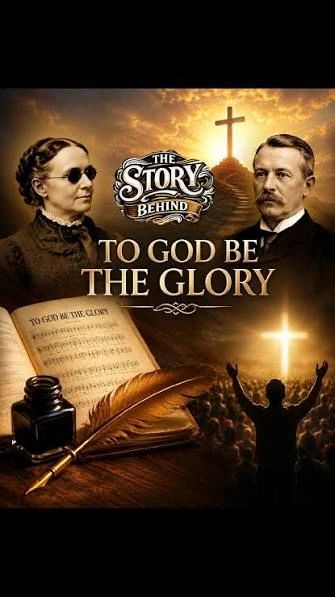
To God Be the Glory is a hymn with lyrics by Fanny Crosby and tune by William Howard Doane, first published in 1875. While it is said that she wrote the lyrics in 1875, some discrepancy remains since it was included in William Doane's Songs of Devotion in 1870. It was already popular in Great Britain before publication. Ira Sankey had introduced it there during Moody's 1873-74 evangelistic campaigns. The song failed to achieve wide usage in the United States and was included in very few hymnals. Through the efforts of Cliff Barrows the song gained in popularity in the United States. Audience response was enthusiastic and with this exposure, the song rapidly became familiar to Christians worldwide and is included in most modern hymnals. Rather than focusing on personal testimony, it stands as an objective theological celebration of God's redemptive work through Jesus Christ. If you're saved today, celebrate the redemptive work through Jesus Christ He has wrought in your life. If you're not saved or you have questions about being saved, please contact us on our Contact Us link in the More drop down menu or call us at the numbers listed at the bottom of the page. We'd love the opportunity to open God's Word and share with you what He says about how you can go to heaven. You can also click on the Know For Sure link at the top of the page.
ABOUT THE AUTHOR
It is said that Frances "Fanny" Crosby wrote more than 8,000 hymns in her lifetime. She was born on March 24, 1820. At six weeks old, Crosby caught a cold and developed inflammation of the eyes. mustard poultices were applied to treat the discharges, ultimately leaving her blind. It is said that she stated "It seemed intended by the blessed providence of God that I should be blind all my life, and I thank him for the dispensation. If perfect earthly sight were offered me tomorrow I would not accept it. I might not have sung hymns to the praise of God if I had been distracted by the beautiful and interesting things about me." and also later "when I get to heaven, the first face that shall ever gladden my sight will be that of my Savior" Annie Willis, had this to say of Crosby, "had it not been for her affliction she might not have so good an education or have so great an influence, and certainly not so fine a memory" Historian Edith L. Blumhofer described the Crosby home environment as sustained by "an abiding Christian faith" Crosby memorized five chapters of the Bible each week from age 10, with the encouragement of her grandmother and later Mrs. Hawley; by age 15, she had memorized the four gospels, the Pentateuch, the Book of Proverbs, the Song of Solomon, and many of the Psalms.
Personal note and encouragement:
She truly, with the help of her grandmother and the almighty help of God, hid His Word in her heart (Psalm 119:105). Let us take note of this and do likewise for in so doing we shall "... be ready always to give an answer to every man that asketh you a reason of the hope that is in you with meekness and fear" (I Peter 3:15)
history
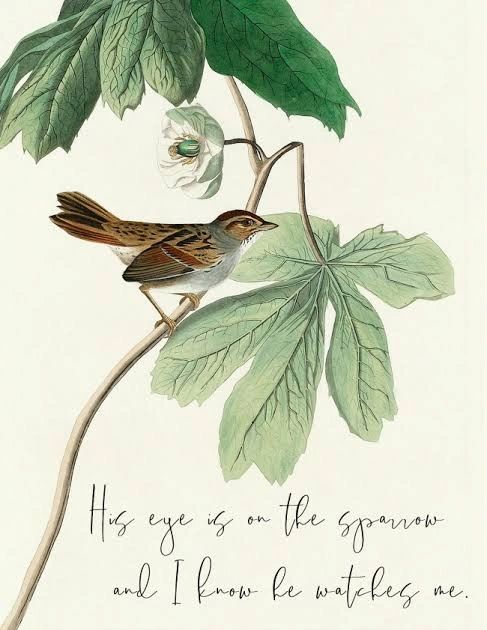
It stands to reason that this week’s song was taken from Scripture – namely Matthew 10:29-31 and Luke 12:6-7, which emphasize that God cares for small sparrows and values human beings even more.
About the Song:
In the spring of 1905, Civilla Martin and her husband were staying in Elmira, New York. They befriended Mr. and Mrs. Doolittle. Mrs. Doolittle had been bedridden for roughly 20 years, and her husband used a wheelchair to get to his business. The couple maintained a joyful, and hopeful Christian faith. When Mrs. Martin asked them why they were so cheerful, Mrs. Doolittle replied: "His eye is on the sparrow, and I know he watches me." It was from this simplistic statement that Civilla gained the inspiration that allowed her to pen the words to this great hymn. This biblically derived hymn has gained in prominence through the years and now 121 years later, it’s one of the most beloved hymns from which we draw hope in times of despair; His eye truly is on the sparrow and I know He watches me (and you).